Introduction
Despite the explosion of smartphone apps and digital channels, millions of callers still reach businesses via landlines, basic cell phones, and feature phones. For these callers, toll-free IVR numbers remain the primary way they get routed, served, and informed—through a phone keypad, with no app or internet connection required.
This reality is often overlooked. According to CDC data from 2024, 42.1% of U.S. seniors (65+) still live in households with landlines, and 22% don't own a smartphone at all. In developing markets like India, 54 million feature phones were shipped in 2024 alone, underscoring the scale of non-smartphone users globally.
When these callers dial your business, an accessible, keypad-navigable IVR system is essential—not optional.
This guide covers what toll-free IVR numbers are, how they work specifically for non-smartphone users, who those users are, and how to set up a system that serves every caller regardless of device.
Key Takeaways
- Toll-free numbers let callers reach your business at no cost; IVR is the automated menu that greets and routes them
- IVR uses DTMF keypad tones—not internet or apps—so it works on any phone, including landlines and basic cells
- Non-smartphone users include elderly populations, rural callers, landline-dependent users, and millions in developing markets
- Businesses that skip IVR optimization for basic phones risk losing substantial inbound traffic and customer satisfaction
- Setup requires no hardware: providers like Tossable Digits include IVR in every plan, so you're live in minutes
Toll-Free Numbers and IVR: What They Are and How They Differ
A toll-free number is a phone number with a recognized prefix—800, 888, 877, 866, 855, 844, or 833—that is free for the caller to dial, with all call costs borne by the business that owns the number. One caveat: while landline callers dial for free, wireless callers may still use airtime minutes unless they have an unlimited calling plan.
IVR (Interactive Voice Response) is an automated phone system that plays pre-recorded audio prompts and responds to a caller's keypad inputs to route calls to the right destination—no human operator needed.
Here's the key distinction: toll-free describes the billing model—who pays for the call. IVR describes the call-handling mechanism: how callers are greeted, prompted, and routed once they connect. They are separate features that are commonly paired together.
How They Work Together
In practice, the toll-free number is the public-facing entry point that removes the cost barrier for callers. The IVR is what those callers encounter immediately after dialing, guiding them through menu options using their keypad.
A common misconception is that IVR requires a smartphone, a data plan, or internet access. It does not. Any phone with a numeric keypad—including basic landlines and standard cell phones—can navigate an IVR menu without data or internet access.
Toll-Free Number Codes and Their Availability
All seven U.S. toll-free prefixes work the same way for callers—the 800 prefix carries legacy recognition but no technical advantage over the others.
Key facts about toll-free number assignment:
- Valid prefixes: 800, 888, 877, 866, 855, 844, and 833
- Governing body: The FCC oversees assignment through certified Responsible Organizations (RespOrgs)
- No brokering allowed: Numbers must be assigned through RespOrgs, not bought or sold directly
- Full portability: Businesses can move their number to a new provider without losing it
How Toll-Free IVR Numbers Work for Non-Smartphone Users
The Call Flow from Start to Finish
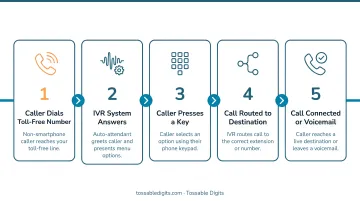
Here's what happens when a non-smartphone caller dials your toll-free IVR number:
- Caller dials the toll-free number on a landline or basic phone
- Call routes through the cloud telephony provider to your IVR system
- IVR system answers with a recorded greeting and menu (e.g., "Press 1 for Sales, Press 2 for Support")
- Caller presses a number on their keypad
- Call is routed to the correct department, agent, or recorded information
The Technology Behind It: DTMF
When a caller presses a key, their phone generates a unique pair of audio tones that the IVR system detects and interprets. This protocol is called DTMF (Dual-Tone Multi-Frequency), standardized by ITU-T Recommendation Q.23.
DTMF operates entirely within the voice-frequency band over telephone lines. It requires:
- No internet connection
- No app
- No special device
Any phone with a standard keypad supports it — landlines, basic feature phones, and smartphones all work without modification.
What Happens on the Business Side
The IVR system is hosted in the cloud, so the business does not need on-site hardware. Incoming calls are answered by the IVR regardless of whether an agent is available, and businesses can configure call routing to forward to any phone number — mobile, landline, or voicemail.
This cloud-based architecture is valuable for small businesses. For example, Tossable Digits includes IVR in every plan with no contracts required, allowing businesses to route calls to any phone without purchasing desk phones or PBX equipment.
Voicemail and Message Retrieval
That same cloud infrastructure handles voicemail without any app on the caller's end. Callers leave messages through standard keypad prompts, and businesses retrieve them via:
- Email — voicemail arrives as an MP3 attachment
- Phone — call in to listen from any device
- Web portal — access recordings directly from the account dashboard
The entire retrieval workflow works from any device.
Limitations for Non-Smartphone Users
Some advanced IVR features rely on smartphone-side apps (visual IVR, click-to-call, in-app menus). These are not accessible to non-smartphone users, which is why keypad navigation needs to handle every common call path — menus, routing, and voicemail — without assuming the caller has a screen.
Who Are Non-Smartphone Users and Why Businesses Cannot Ignore Them
Key Segments
Elderly Populations: Research shows seniors disproportionately rely on landlines and basic phones. As of 2024, 42.1% of U.S. seniors (65+) live in households with landlines, and 22% do not own a smartphone.
Rural and Low-Income Households: Only 73% of rural adults subscribe to high-speed home broadband, compared to 86% of suburban adults. CDC data indicates that non-metropolitan adults have a lower wireless-only rate (72.9%) compared to metropolitan adults (75.5%), indicating higher landline retention in rural areas.
Developing Markets: In India, 54 million feature phones were shipped in 2024 alone — a clear signal that hundreds of millions still rely on basic handsets for daily communication.
Beyond these demographics, many callers simply prefer voice for urgent or sensitive issues — regardless of what device they own.
India's 1800-Series IVRS Infrastructure
India's TRAI (Telecom Regulatory Authority of India) has mandated toll-free IVRS (Interactive Voice Response System) infrastructure specifically designed so that non-smartphone users can access services by calling a toll-free number and navigating IVR menus via keypad—no internet or data required.
Examples include:
- Kisan Call Centre (1800-180-1551): Accessible via mobile and landline across all telecom networks; answers farmers' queries in 22 local languages
- National Consumer Helpline (1800-11-4000): Toll-free grievance redressal service operated by the Department of Consumer Affairs
Both numbers are free to the caller. The operating business or government agency covers the cost, removing any barrier for callers without data plans or smartphones.
The Business Risk of Ignoring This Segment
The stakes are real. According to Five9 research from 2025, 74% of consumers prefer phone support for complex or urgent matters, and 86% say empathy and human connection matter more than a quick response.
An IVR system that locks out basic phone users doesn't just limit reach — it actively drives customers away. Vonage research found:
- 61% of consumers say reaching an IVR menu makes for a poor experience
- 51% have abandoned a business entirely because of an automated menu
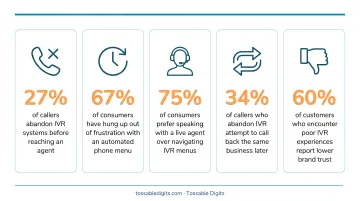
Every caller who can't get through is a lost opportunity — and often a lost customer.
Designing IVR Menus That Work on Any Phone
Keep the Menu Hierarchy Shallow
Limit your IVR to 2–3 levels with no more than 4–5 options per level. Non-smartphone callers cannot glance at a visual reference or pause the call to look up options; they must hold the entire menu structure in memory.
Industry data from ContactBabel shows that 28% of contact centers use a single menu level, while 24% of large centers use 4+ levels, which causes frustration and abandonment.
Write Prompts with the Non-Smartphone Listener in Mind
Keep the following in mind when writing each prompt:
- Use plain language and read each option in full before asking callers to press a key
- Keep individual prompts under 10 seconds
- Avoid jargon, acronyms, or instructions that assume the caller is looking at a screen
Those time limits matter in practice. ContactBabel data shows only 23% of contact centers keep initial instructions under 15 seconds, while 42% run between 15–30 seconds — long enough to lose a non-smartphone caller before they've heard all their options.
Always Include an Escape Route
Every IVR level should offer a clear escape path. At minimum:
- Include a "press 0 to speak with an agent" option at each menu level
- Route callers who press nothing to a live agent or general voicemail by default
Non-smartphone users — particularly those less familiar with IVR navigation — need a reliable fallback. ContactBabel reports a mean "zero-out" rate of 32%, meaning nearly one in three callers abandon self-service for a live agent regardless of menu design.
Test the IVR on Actual Non-Smartphone Devices Before Launch
Dial through the full menu on a landline and a basic cell phone to verify that:
- DTMF tones are recognized correctly
- Audio quality is clear
- No steps assume visual or app-based interaction
- Timing and prompt length work for real-world use
Pay close attention to prompt pacing and audio clarity — these are the issues most likely to surface on older devices that never appear in a software preview.
How to Get a Toll-Free Number with IVR for Your Business
Choose a Virtual Phone Number Provider
Select a provider that bundles IVR as a standard feature—not a paid add-on—alongside toll-free number access and call forwarding.
Tossable Digits, for example, includes IVR in every plan at no extra cost, with forwarding to any phone type—mobile, landline, or virtual phone—and no contract required.
Basic Setup Process
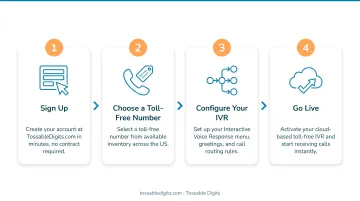
Step 1: Sign up with a provider and select a toll-free number from available prefixes (800, 888, 877, 866, 855)
Step 2: Record or upload IVR greeting and menu prompts (e.g., "Press 1 for Sales, Press 2 for Support")
Step 3: Configure keypad routing rules to direct calls to the appropriate numbers or voicemail
Step 4: Test each menu option to confirm calls route correctly before going live
No hardware required. The entire system is cloud-based and activates within minutes.
What to Look for in a Provider
Key features that matter for businesses serving a mix of smartphone and non-smartphone users:
- IVR included in base plan (not as a paid add-on)
- Call forwarding to any number type (mobile, landline, virtual phone)
- Voicemail-to-email delivery with audio attachments (MP3)
- Call recording with auto-announcement to stay legally compliant
- No per-minute surprises (flat-rate or clearly documented billing)
- No-contract policy with the ability to cancel anytime
Frequently Asked Questions
How does an IVR number work?
An IVR system answers incoming calls with a pre-recorded menu, detects the caller's keypad presses (DTMF tones), and automatically routes the call to the correct department or plays the requested information. No human operator is required.
Can I call a toll-free number for free?
Calls to toll-free numbers (800, 888, 877, etc.) are free for callers dialing from a landline, with the business paying all charges. Mobile callers may use airtime minutes unless they have an unlimited calling plan.
What is the toll-free IVRS number for non-smartphone users in India?
India operates a TRAI-regulated toll-free IVRS infrastructure, with government and private services accessible via 1800-series numbers. Callers on basic phones or landlines can navigate these menus via keypad without a smartphone or data connection.
Can you use a toll-free number on a cell phone?
Yes, toll-free numbers work on any phone — landline, basic cell phone, or smartphone. For cost details on mobile calls, see the question above about calling toll-free numbers for free.
What is the difference between IVR and a toll-free number?
A toll-free number defines who pays for the call (the business, not the caller), while IVR is the automated menu system that answers and routes those calls. They're often paired, but serve different purposes.
Can an IVR system integrate with other systems?
Modern IVR systems integrate with CRMs, helpdesk platforms, call recording tools, and voicemail-to-email services. These back-end connections let businesses capture and manage caller data entirely on their side — no app or smartphone required from the caller.