Introduction
If your business texts customers from a toll-free number and you haven't registered with the SMS/800 TFN Registry, your messages may never arrive. The SMS/800 TFN Registry is the official U.S. database governing how toll-free numbers are assigned, routed, and authorized for SMS/MMS messaging — and registration isn't optional.
Most businesses understand that toll-free numbers work for calls, but the SMS compliance layer is a different story. Unregistered numbers are blocked outright at the carrier level — no delivery, no fallback.
AT&T, T-Mobile, and Verizon all enforce this universally, blocking SMS/MMS traffic from unregistered toll-free numbers to combat spam and fraud. Canadian carriers follow the same policy.
Key Takeaways
- The SMS/800 TFN Registry, managed by Somos, Inc., controls all toll-free number assignments and SMS authorization in North America
- Any toll-free number (800, 888, 877, 866, 855, 844, 833) used for commercial SMS or MMS must be registered
- Unregistered toll-free numbers will have their messages blocked by wireless carriers—registration is not optional
- Required documentation includes business details, use case description, opt-in consent proof, and sample messages
- As of February 2026, a Business Registration Number (EIN for U.S. businesses) is now mandatory
What Is the SMS/800 TFN Registry?
The SMS/800 TFN Registry is the national database that administers all toll-free number assignments, routing data, and SMS authorization for the North American Numbering Plan (NANP). Somos, Inc. has operated it since 2013 under FCC mandate. Covered prefixes include 800, 888, 877, 866, 855, 844, and 833.
The Responsible Organization (Resp Org)
A Responsible Organization (Resp Org) is the entity—such as a carrier or virtual number provider like Tossable Digits—assigned to manage a toll-free number's record in the registry on behalf of the end business. Businesses typically work through a provider rather than accessing the registry directly.
Registry vs. Carrier Registration
Two related but separate systems govern toll-free numbers:
- SMS/800 TFN Registry: Handles top-level routing data and number assignment
- Carrier-side TFN SMS registration: A separate process where businesses submit their use case and opt-in proof to get SMS/MMS traffic approved by carriers
In practice, passing registry-level assignment does not automatically enable SMS. Carrier registration is the separate step that determines whether a number can actually send and receive messages.
Why Your Toll-Free Number Needs to Be Registered for SMS
U.S. wireless carriers require all toll-free numbers used for commercial SMS and MMS to be registered and approved before messages are delivered. Unregistered TFNs will have their messages blocked at the carrier network level—100% of unregistered traffic faces blocking.
What You Lose Without Registration
Without registration, businesses face real operational consequences:
- Complete message blocking — no texts reach recipients at all
- Damaged sender reputation with carriers
- Silent delivery failures that are invisible to senders and customers alike
- Lost revenue from failed transactional alerts and confirmations
Who Needs to Register
Any business or individual sending commercial, promotional, transactional, or alert-based SMS from a toll-free number to U.S. or Canadian recipients must register. This includes:
- Appointment reminders
- Order confirmations
- Marketing messages
- Two-factor authentication codes
- Customer service notifications
- Account alerts
Voice-only toll-free numbers do not require this registration. As of 2021, over 5 million toll-free numbers were text-enabled — a figure that has grown substantially as businesses increasingly rely on SMS for customer communication.
Getting a Number vs. Registering for SMS
These are two separate steps:
- Obtain the toll-free number through a provider like Tossable Digits, which offers toll-free virtual numbers with SMS capabilities
- Submit SMS use case registration to carriers through your provider
Both steps must be completed before messages can be sent.
Registration Doesn't Guarantee Deliverability
Completing registration clears the carrier compliance hurdle, but content rules still apply. Messages containing prohibited categories will be blocked regardless of registration status:
- Cannabis and CBD (strictly prohibited)
- Payday loans or short-term high-interest loans
- Third-party debt collection
- Gambling
How the TFN SMS Registration Process Works
The TFN registration process involves three steps: documenting your business identity, defining your messaging program, and proving how recipients consent. Your provider submits the completed form to carriers, where a third-party vetting entity reviews it before approval. Understanding what each step requires — and where applications commonly fail — saves significant back-and-forth.
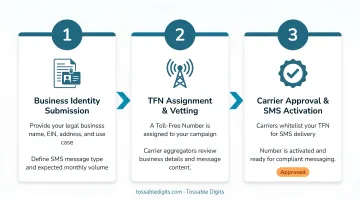
Step 1: Provide Business and Contact Information
Required information includes:
- Organization name and registered address
- Active, secure business website with SMS Terms and Privacy Policy
- Contact person with email that matches the company domain (preferred)
- Entity type and Tax Identifier (mandatory after February 17, 2026): A Business Registration Number — such as an EIN for U.S. businesses or a BN for Canadian businesses — is required for all new TFN registrations, except for sole proprietors
The business website must be publicly accessible and clearly reflect the messaging program described in your registration.
Step 2: Define Your Use Case and Message Content
Businesses must select a Use Case Category such as:
- 2FA/OTP (two-factor authentication)
- Marketing
- Alerts and notifications
- Transactional updates
- Customer care
Sample message requirements:
- Must match the declared category
- Include the brand name or DBA
- Use bracket notation for variable fields (such as
[Name]or[Order Number]) - Be at least 20 characters long
Critical warning: Inconsistency between the use case category and the message samples is a leading cause of rejection. If you select "alerts" but submit marketing samples, your registration will be denied.
Step 3: Document the Opt-In Consent Workflow
Reviewers look for these mandatory opt-in elements:
- Explicit consumer agreement referencing the brand name and message type
- No pre-checked boxes
- Message frequency disclosure — for example, "Message frequency varies"
- Opt-out instructions — "Reply STOP to unsubscribe"
- HELP support contact — "Reply HELP for support"
- Standard disclosure: "Message and data rates may apply"
- Links to publicly accessible Terms and Privacy Policy pages
If opt-in is verbal or paper-based, a script or letter on company letterhead is required.
Key Factors That Determine Registration Approval
All TFN registration submissions are reviewed by a third-party vetting entity—not the provider or carrier directly. Reviewers are human and evaluate whether the use case description is clear and credible without prior knowledge of the company. Vague, inconsistent, or boilerplate answers are the most common rejection triggers — so the signals below are what reviewers actually look for.
Critical Approval Signals
Approvals hinge on four factors:
- Use case category and sample messages tell a consistent story
- Opt-in page is publicly accessible and includes all required disclosures
- Business website is active and reflects the stated messaging program
- Contact email matches the company domain where possible
Registration Status Lifecycle
| Status | Meaning | What to Do |
|---|---|---|
| Pending Review | Submission accepted, awaiting manual review | Wait; traffic remains restricted |
| Carrier Review | Under carrier evaluation | Wait; review typically takes 5-7 business days |
| Updates Required | Correctable issues identified | Fix and resubmit (common fixes: missing disclosures, inaccessible website) |
| Registered | Approved; messages flow normally | No action needed |
| Rejected | Permanently denied; not eligible for resubmission | Common causes: prohibited content, severe SHAFT violations, fraud |
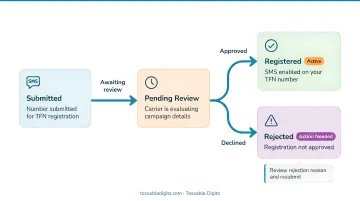
"Updates Required" can be resubmitted after corrections. "Rejected" is permanent — no resubmission path exists.
Special Compliance Requirements
Political messaging: As of February 17, 2026, 527 political organizations must provide a valid Campaign Verify (CV) Authorization Token to register a TFN for messaging. Failure to provide this token results in automatic rejection.
Age-gated content: Alcohol, firearms, and tobacco require robust age-gating. This means the end user must manually enter their birthdate (e.g., MM/DD/YYYY). Simple "Yes/No" buttons or "Reply YES" prompts are not considered robust age verification and will result in rejection.
Common Mistakes and Misconceptions About TFN Registration
Registration Is Not One-Time
Registration approval is based on the accuracy and completeness of the submitted information. Businesses that change their messaging program—such as adding marketing messages after registering only for alerts—may need to re-register or update their record. Ongoing compliance with the declared use case is expected.
Generic Use Case Descriptions Fail
Reviewers are looking for specific, plain-language explanations of:
- Who the recipients are
- How they opted in
- What value the messages provide
Copying boilerplate language or submitting vague answers sharply raises your rejection risk. Write as if explaining your program to someone who has never heard of your company.
TFN vs. 10DLC vs. Short Code Confusion
Getting clear on channel differences helps avoid a common planning mistake. TFN registration is generally faster and simpler than 10DLC brand/campaign registration, but comes with lower throughput. While "3 messages per second (MPS)" is a common vendor default, there is no industry-wide TFN speed limit — some platforms cap traffic much lower (some cap at 40 messages/minute).
Channel comparison:
- Toll-Free Numbers: Moderate throughput, moderate vetting complexity, best for customer support and alerts
- 10DLC: Variable throughput based on Trust Score, high vetting complexity, best for localized marketing
- Short Codes: Highest throughput (15-60+ MPS), very high vetting complexity, best for high-volume alerts and mass marketing
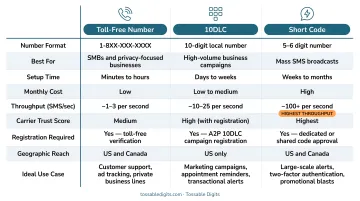
TFN registration is not a substitute for Short Codes in high-volume broadcast scenarios.
Frequently Asked Questions
What is a toll-free phone number (TFN)?
A TFN is a 10-digit phone number with a toll-free prefix (800, 888, 877, 866, 855, 844, or 833) that is free to call for the person placing the call, with the recipient bearing the charges. In the U.S. and Canada, TFNs can also send and receive SMS and MMS messages.
What is toll-free SMS?
Toll-free SMS refers to sending and receiving text messages using a toll-free number as the originating identity. This is only available in the U.S. and Canada, and the number must be registered for SMS use before messages will be delivered by carriers.
How do I look up who owns an 800 toll-free number?
Toll-free number ownership can be looked up through the SMS/800 TFN Registry managed by Somos, Inc., which tracks the Responsible Organization (Resp Org) assigned to each number. Full subscriber details are not publicly disclosed — only the assigned Resp Org is visible.
Are 800 numbers toll free internationally?
U.S. 800 numbers are toll-free domestically, but international toll-free access varies by country. Callers dialing a U.S. 800 number from abroad may incur standard international call charges. Some businesses use international freephone numbers for true toll-free international access.
Which country uses +1 800 numbers?
+1 800 numbers are part of the North American Numbering Plan (NANP), shared by the United States, Canada, and other NANP territories such as Puerto Rico and certain Caribbean nations. In practice, toll-free 800 service — where the recipient pays and the caller does not — is a U.S. and Canada feature; callers from other NANP territories may still be charged.