Many people assume toll-free numbers only work in the US, or that different prefixes like 800 versus 866 function differently. This guide clears up those misconceptions and explains how the system works, who pays for calls, what mobile users need to know, and how Canadian businesses can get their own 866 number.
TLDR: Key Takeaways
- 1-866 numbers are toll-free in Canada—landline callers pay nothing
- 866 is one of seven toll-free prefixes (800, 833, 844, 855, 866, 877, 888) that work equally across Canada and the US
- The business owning the number pays for incoming calls, not the caller
- Mobile users may be charged airtime minutes unless they have unlimited calling plans
- Any business can get a Canadian 866 toll-free number through a virtual provider like Tossable Digits—providers like Tossable Digits offer them with no contracts required
What Makes 1-866 Numbers Toll-Free in Canada?
The North American Numbering Plan (NANP)
Canada and the US share a unified telephone numbering system called the North American Numbering Plan (NANP). This integrated plan serves 20 countries, including the US, Canada, and 18 Caribbean nations, all sharing the country code 1. The North American Numbering Plan Administration (NANPA) manages numbering resources across all member countries, while COMsolve Inc. serves as Canada's national administrator.
Because Canada participates in NANP, all toll-free prefixes—including 866—work identically in both countries. When you dial 1-866-XXX-XXXX from Canada, the call routes seamlessly to the business that owns the number, regardless of whether that business is in Toronto, New York, or anywhere else in North America.
What "Toll-Free" Actually Means
According to the FCC's official definition, a toll-free number is a telephone number with a distinct three-digit code that can be dialed from landlines with no charge to the caller. Instead, the toll charges are paid entirely by the "toll-free subscriber": the business or organization that owns the number.
The "1" you dial before 866 is the NANP country code shared by both the US and Canada. From a Canadian landline, you can often omit the "1", but the call routes identically whether you include it or not.
When Were Toll-Free Numbers Introduced in Canada?
Toll-free 800 service originated in the United States in 1967 as AT&T's inbound Wide Area Telephone Service (InWATS). Initially, US and Canadian 800 numbers operated separately. However, a 1984 agreement between carriers in both countries allowed these numbers to become accessible across the border.
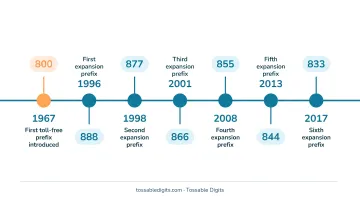
The 866 prefix was introduced on July 29, 2000, as demand for toll-free numbers grew and the original 800 pool became depleted. Today, NANP recognizes seven active toll-free prefixes, all of which work throughout Canada:
- 800 — the original prefix, introduced 1967
- 888 — added 1996
- 877 — added 1998
- 866 — added 2000
- 855 — added 2010
- 844 — added 2013
- 833 — added 2017
No Geographic Meaning
Unlike local area codes (416 for Toronto, 514 for Montreal, 604 for Vancouver), the 866 prefix has no geographic meaning. It simply signals "toll-free" and routes to wherever the number owner has configured it—whether that's a cell phone in Calgary, an office in Ottawa, or a call center anywhere in North America.
All Toll-Free Prefixes Available in Canada
Canada recognizes all seven active NANP toll-free prefixes:
- 800 (introduced 1967)
- 888 (introduced March 1996)
- 877 (introduced April 1998)
- 866 (introduced July 2000)
- 855 (introduced October 2010)
- 844 (introduced December 2013)
- 833 (introduced June 2017)
All these prefixes work exactly the same way from a caller's perspective—free to call from Canadian landlines. However, they are not interchangeable. Dialing 1-866-555-1234 reaches a completely different business than 1-800-555-1234, even though both are toll-free.
The 866, 877, and 888 prefixes were added progressively as demand depleted the original 800 pool. Additional prefixes (822, and the 880-887 and 889 ranges) are reserved for future use.
Vanity Numbers Work the Same Way
That same flexibility extends to vanity numbers. Any toll-free prefix can be paired with a word-based format like 1-866-FLOWERS or 1-800-BUY-CARS. These work identically to standard numeric toll-free numbers, but make the number easier to remember in ads and on signage. Tossable Digits offers vanity toll-free numbers with no premium fees for available combinations.
Who Pays When You Call an 866 Number in Canada?
The person calling an 866 number from a Canadian landline pays nothing. The business that owns the toll-free number pays for each incoming call, typically based on call duration and volume through their service provider.
What About Calling from a Mobile Phone?
Mobile callers may still be charged airtime minutes when dialing toll-free numbers. The toll-free designation only guarantees you won't pay long-distance fees — it doesn't override your mobile plan's airtime usage.
Canadian carriers handle toll-free calls this way:
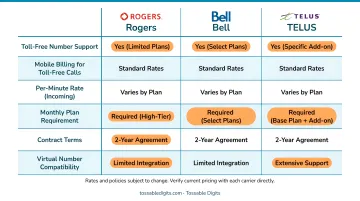
If you have an unlimited calling plan, you're unaffected. But pay-as-you-go or minute-based plan users should be aware their minutes will be consumed.
Text Messaging to Toll-Free Numbers
SMS to toll-free numbers is possible if the number is "text enabled" by the provider. The FCC requires explicit authorization from the number's owner before text-enabling toll-free numbers. When texting is enabled, the business pays for inbound and outbound texts (typically $0.0065 to $0.0083 per message), but your mobile carrier's messaging plan terms may still apply.
Are 866 Numbers Safe to Call in Canada?
866 numbers are legitimate toll-free numbers used by businesses, government agencies, and organizations — but scammers do spoof them. The billing mechanics are straightforward; the risk lies in who's on the other end. In 2024, the Canadian Anti-Fraud Centre logged 108,878 fraud reports totaling $643.7 million CAD in losses.
If you receive an unsolicited call from an 866 number, verify the caller's identity before providing personal information. The CRTC warns that scammers frequently alter caller ID to misrepresent themselves as recognizable brands or government organizations. When in doubt, hang up and call the organization's official number directly.
Why Canadian Businesses Use 866 Numbers
Credibility and Trust
Having a toll-free 866 number gives any business—regardless of size—a professional, nationwide presence. Customers perceive toll-free numbers as a sign of an established company.
That credibility translates to real results: a 2025 Invoca benchmark report analyzing over 60 million phone calls found that 37% of qualified leads convert during the call itself.
Reduced Friction to Contact
Toll-free numbers remove the one thing that stops customers from picking up the phone: cost. For customer service lines, support teams, and inbound sales, that single change can measurably increase call volume and the number of leads you close.
Geographic Flexibility
One 866 number covers your entire reach — Vancouver, Toronto, Montreal, or anywhere in the US — with no separate lines per city. Calls forward to any phone you choose, which makes this setup practical for:
- Remote-first businesses managing a distributed team
- Solo entrepreneurs who need a professional number without a physical office
- Companies expanding nationally without committing to local numbers in every market
How to Get an 866 Toll-Free Number in Canada
Businesses can obtain an 866 (or any toll-free prefix) number in minutes through a virtual phone number provider. The process typically involves:
- Choose a provider - Select a certified Responsible Organization (RespOrg) that manages toll-free numbers
- Select your number - Browse available 866 numbers or request a custom vanity combination
- **Set up call forwarding** - Route calls to your existing phone (mobile, landline, or virtual phone)
- Activate features - Configure voicemail, IVR, SMS, and call recording as needed
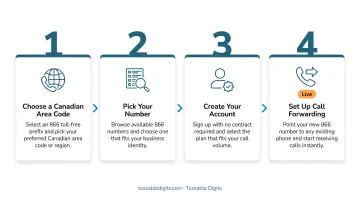
No hardware or contracts are required — setup is fully digital. That said, the provider you choose matters more than the prefix.
What to Look for in a Provider
Not all toll-free providers offer the same terms. Before committing, check for:
- Number portability — both the FCC and Canada's CRTC mandate that you can transfer your toll-free number if you switch providers
- Included features — call forwarding, voicemail-to-email, IVR, call recording, and SMS should come standard, not as paid add-ons
- Transparent pricing — clear monthly and per-minute rates, no hidden fees, and no long-term contracts
Tossable Digits offers Canadian toll-free numbers with all 60+ features included in every plan: call recording, IVR, SMS, and voicemail-to-email. There are no contracts, and numbers forward to any phone globally — useful for individuals, small businesses, and operations that span the US-Canada border.
Frequently Asked Questions
Are 1 866 numbers toll-free in Canada?
Yes, 1-866 numbers are toll-free in Canada because Canada participates in the North American Numbering Plan (NANP). Landline callers are not charged; the business owning the number pays for the call.
Is 1866 a Canadian number?
No, 866 is not specifically a Canadian area code—it is a NANP toll-free prefix shared across the US, Canada, and other participating countries. A business anywhere in the NANP region can hold the number.
Is a 1-800 number free in Canada?
Yes, 1-800 numbers are free to call from Canadian landlines and work exactly the same way as 866, 877, 888, and other toll-free prefixes under the NANP. Mobile callers should check their plan for potential airtime charges.
Is 888 free to call in Canada?
Yes, 888 is a toll-free prefix under the NANP, just like 800 and 866. Landline callers in Canada are not charged.
Do Canadians get charged for calling US numbers?
Calling a US toll-free number (any NANP toll-free prefix) from Canada is free for landline callers. However, calling a regular US local number from Canada may incur long-distance charges depending on your phone plan.
What happens if I call an 866 number?
When you dial an 866 number, your call routes through the NANP system to whichever phone the 866 subscriber has configured for forwarding. Landline callers are not charged; the business receiving the call pays for it.