For most small businesses, the answer is no. That random string of digits you were assigned gets forgotten the moment the customer looks away. Vanity phone numbers — memorable combinations like 1-800-FLOWERS or 877-FIX-LEAK — solve this exact problem. They're often dismissed as a luxury reserved for national brands, yet research shows vanity numbers achieve 72% recall after radio ads compared to just 5% for numeric strings. For businesses of any size relying on inbound calls, that gap represents real revenue.
This article breaks down whether a vanity number delivers measurable value for your small business — not theoretical brand benefits, but concrete ROI in the channels where you're already spending money.
Key Takeaways
- Vanity numbers replace random digits with words or patterns (1-800-PLUMBER), making them dramatically easier to recall
- 72% of listeners remember vanity numbers after radio ads versus 5% for numeric strings
- High ROI for service businesses, competitive industries, and traditional media campaigns
- Tossable Digits offers vanity numbers with no contracts — SMS, call recording, and voicemail are included in every plan
- Once customers memorize your number, that recall works for free on every billboard, truck wrap, and radio spot
What Is a Vanity Phone Number?
A vanity number replaces random digits with a word, phrase, or repeating pattern tied directly to your brand or service. Examples include 1-800-PLUMBER, 888-BUY-CARS, or 555-5555.
Three Main Types
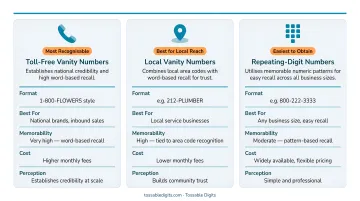
Toll-free vanity numbers use prefixes like 800, 888, 877, or 866 and work nationwide. They signal professionalism and eliminate cost concerns for callers across wide geographic areas.
Local vanity numbers feature your area code, establishing geographic presence. A roofer in Phoenix might use (602) NEW-ROOF, signaling both locality and service in seven digits.
Numeric pattern numbers use repeating or sequential digits (888-7777 or 800-1234) when meaningful words aren't available. While less descriptive than word-based numbers, patterns still achieve higher recall than random strings.
A Marketing Asset, Not Just a Phone Line
A vanity number functions as branding infrastructure — it earns its keep every time it appears in front of a potential customer. Where a paid campaign stops working the moment the budget runs out, a vanity number keeps delivering as long as it stays in use.
Common placements where it works continuously:
- Vehicle wraps and yard signs (seen repeatedly in local markets)
- Radio and podcast spots (where listeners can't click a link)
- Business cards, invoices, and email signatures
- Billboards and out-of-home advertising
Key Advantages of Vanity Phone Numbers for Small Businesses
The advantages below are grounded in documented recall rates, call volume studies, and consumer behavior research. Each compounds over time as your number appears across more touchpoints.
Advantage 1: Far Higher Customer Recall
The biggest challenge with standard phone numbers is simple: customers forget them immediately. Your radio ad ends, your truck drives past, your billboard fades from view — and the number is gone.
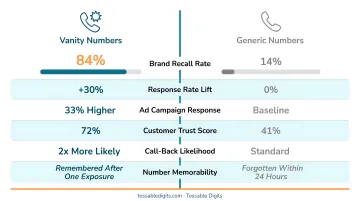
Vanity numbers solve this by converting digits into meaningful words the brain retains. Research shows 72% of people recall vanity numbers after hearing a 30-second radio ad, compared to just 5% for numeric strings. In visual media like TV and billboards, vanity numbers generate an 84% improvement in recall.
If you're running offline advertising — radio spots, vehicle wraps, billboards, event signage — most of your ad spend is wasted if customers can't remember how to reach you. A vanity number turns every impression into a retrievable memory.
This directly affects inbound call volume, cost-per-call, and repeat contact rates from existing customers.
The impact is sharpest in interruptive advertising — contexts where customers can't click a link. Radio listeners driving to work, commuters stuck behind your branded truck, attendees walking past your trade show booth: they must remember your number or you lose the call.
### Advantage 2: A Built-In Call-to-Action Across Every Channel
A vanity number doesn't just help people remember — it makes every marketing investment pull more weight. Ads featuring vanity numbers yield 33% higher click-through rates in mobile search compared to those with generic numbers. In traditional media, A/B testing shows vanity numbers can lift inbound call volume by 48%.
One memorable number can anchor radio, print, social media, and vehicle branding simultaneously. You're not creating separate CTAs for each channel. The number itself is the action.
Key metrics this affects:
- Ad response rate across all channels
- Cost-per-lead (fewer wasted impressions)
- Word-of-mouth referral conversion
Service businesses in competitive local markets feel this most acutely — plumbing, roofing, legal services, real estate, HVAC. These are industries where emergency or impulse calls happen fast. The business whose number surfaces first in a customer's memory wins.
Advantage 3: Instant Credibility and Professional Perception
A vanity number signals investment in your business. It tells prospects you're established, intentional, and worth taking seriously.
Research from NumberBarn shows consumers are 35% more likely to call a business with a vanity number and 18% more likely to choose that business over competitors. That perception gap exists before the first conversation happens.
Small businesses often compete against larger, more established players. A generic number like (555) 438-9271 signals nothing. A number like 1-800-FIX-LEAK signals professionalism, brand awareness, and permanence — before any conversation starts.
This matters most for new or early-stage businesses. A vanity number does credibility work before your website, reviews, or portfolio can. It shifts the first impression from "who is this?" to "these people mean business."
Metrics it affects:
- Conversion rate from first contact
- Trust perception in cold advertising
- Customer acquisition through referrals
What Happens When Small Businesses Skip the Vanity Number
Most small businesses default to whatever random number their phone provider assigns. That number might be (555) 834-2917 or 1-877-438-9201 — strings no human brain retains without conscious effort.
The Compounding Cost of Forgettability
Every ad impression that doesn't result in an immediate call is essentially wasted. Customers who heard your radio spot or saw your truck wrap can't recall your number when they actually need you. They call the competitor whose number stuck — or Google your service category and click whoever ranks first.
That's a direct revenue leak. You paid for the impression and earned the attention — but lost the conversion because the number didn't stick.
The Missed Word-of-Mouth Multiplier
Forgettable numbers don't just hurt paid advertising — they quietly undercut organic referrals too. When a satisfied customer recommends your business verbally, a generic number creates friction. They have to look it up, then text it to their friend, or they drop the referral entirely. A vanity number removes that step. Your customer can simply say "Call 1-800-PLUMBER," and the referral is done.
When a Vanity Number Is Worth It — and When It's Not
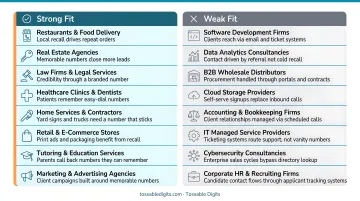
Vanity numbers deliver the clearest return for businesses that meet one or more of these criteria:
The fit is strongest when:
- Running offline advertising (radio, billboards, vehicle wraps, direct mail)
- Serving customers who call during urgent moments (plumbers, locksmiths, towing, legal)
- Competing in crowded local markets where differentiation is difficult
- Building through word-of-mouth referrals (contractors, real estate, professional services)
- Coordinating multi-channel marketing that needs one consistent number everywhere
The fit is weaker when:
- Operating almost entirely through digital channels with minimal phone interaction
- Running e-commerce where transactions happen online and calls are rare
- Working as a solopreneur with no ad budget and no plans to scale
- Serving customers with very short lifecycles where repeat contact is unlikely
The Practical Entry Point
Cost is often what stops businesses from testing a vanity number — but that barrier is lower than it used to be. Unlike traditional telecom providers that charge premium fees and lock customers into long-term contracts, platforms like Tossable Digits offer local, toll-free, and international vanity numbers month-to-month, with call forwarding, voicemail, SMS, and call recording included at no extra charge. That makes it practical to run a real-world test before committing to any long-term strategy.
How to Get the Most Value from Your Vanity Number
A vanity number only works if it appears everywhere, consistently. Half-adoption defeats the purpose.
Where Your Number Must Appear
- Business cards and email signatures
- Vehicle wraps and fleet branding
- Social media profiles (Facebook, LinkedIn, Instagram)
- Website headers and contact pages
- All paid advertising (radio, print, digital, outdoor)
- Voicemail greetings and hold messages
- Invoices and receipts
Tips for Choosing a Number That Actually Sticks
Keep it short and unambiguous: 1-800-FIX-LEAK is better than 1-800-PLUMBINGREPAIR. Every extra letter is a chance for someone to forget or misdial.
Avoid letter-digit confusion: The letters O and I look like the digits 0 and 1. Avoid combinations that create ambiguity (like 1-800-CHOICE, where the "O" could be mistaken for zero).
Always display the numeric version: In print ads, show both: 1-800-FLOWERS (1-800-356-9377). This removes guesswork for customers unfamiliar with phone keypads.
Test recall before committing: Ask someone unfamiliar with your business to listen to your number once, then repeat it back an hour later. If they can't, keep refining.
Enable SMS on Your Vanity Number
Once your number is locked in, make sure it can do more than ring. Modern virtual number platforms support text messaging on vanity numbers — and skipping this step costs you real leads. NumberBarn research shows 21% of consumers have attempted to text a business vanity number, with that percentage jumping to 38% among Generation Z. If your vanity number can't receive texts, you're missing inquiries — especially from younger customers.
Conclusion
For most small businesses that rely on inbound calls, advertise in any offline channel, or compete in crowded local markets, a vanity number is a genuine marketing asset — not a vanity purchase.
The value compounds over time. Unlike a one-time campaign that ends when the budget runs out, a well-chosen vanity number works continuously across every touchpoint where your business appears. It becomes more valuable the longer it's in use and the more consistently it's promoted.
If you're investing in brand visibility but losing conversions because customers can't remember how to reach you, a vanity number closes that gap: turning impressions into calls and calls into customers.
If you're ready to find the right number, Tossable Digits lets you search and claim vanity numbers with no contracts and every feature included from day one.
Frequently Asked Questions
Are vanity toll-free numbers still worth it?
Yes. 90% of Americans use toll-free numbers, and recall rates for vanity numbers far exceed generic numeric strings. They're especially valuable for businesses advertising nationally or across wide geographic areas.
How do I choose a vanity toll-free number?
Start with short words or phrases that reflect your service, then work through this checklist:
- Check availability across all prefixes (800, 888, 877, 866)
- Keep it unambiguous — avoid letters that map to multiple sounds
- Always show the numeric version alongside the word version in ads
- Test recall with someone unfamiliar with your business before committing
What is a vanity phone number?
A vanity number uses the phone keypad to spell a word or phrase (1-800-PLUMBER) or features a memorable repeating pattern. Branded numbers like these are recalled at significantly higher rates than random numeric strings — which is why they've been a direct-response advertising staple for decades.
How much does a vanity phone number cost?
Most vanity numbers are priced the same as standard virtual phone numbers — Tossable Digits, for example, includes vanity number selection at no added cost. Premium or highly sought-after combinations may carry a one-time acquisition fee, but monthly costs are in line with any standard business phone plan.
Do vanity numbers work for text messaging?
Yes. Most modern virtual phone platforms support SMS on vanity numbers, and this matters because research from NumberBarn found that a significant share of consumers have already tried texting a business vanity number — particularly younger customers.
What if the vanity number I want is already taken?
Try alternate prefixes (888, 877, 866, 844), slight word variations, adding a location or action verb, or consider a local area-code vanity number. Availability is better outside the 800 prefix.