Introduction
The # symbol creates constant confusion. The same character goes by different names depending on where you are and what you're using it for: it's a "hashtag" on social media, a "pound sign" on your phone, a "hash" in the UK, and a "number sign" on your keyboard. Yet all four names refer to the exact same symbol. Where did all these names originate, and how does this linguistic tangle connect to vanity phone numbers?
This article explains three key things: the many names of #, its surprising journey onto the telephone keypad, and how understanding that history helps you appreciate the marketing power behind vanity phone numbers. Businesses that understand how phone keypads map letters to numbers gain a practical edge: they can turn a string of digits into a word customers actually remember and dial.
Key Takeaways
- The # symbol has five common names: hashtag, pound sign, hash, number sign, and octothorpe—each with different origins and regional usage
- Bell Labs added # to phone keypads in 1968 for touch-tone dialing and coined "octothorpe" as an internal nickname
- Keypad letter-to-number mapping (2=ABC, 3=DEF) makes vanity phone numbers like 1-800-FLOWERS possible
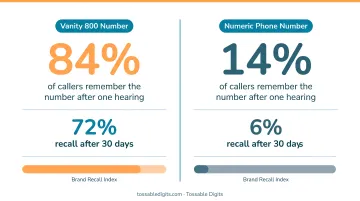
- Vanity numbers improve brand recall by up to 84% in visual ads compared to numeric strings
- Businesses can get local or toll-free vanity numbers through Tossable Digits—no contracts or premium fees required
What Is the # Symbol Actually Called?
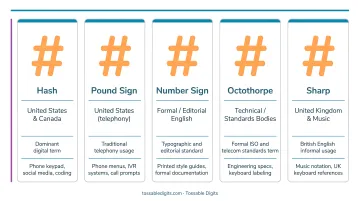
The # symbol has no single correct name. Its identity depends entirely on geography, context, and era. The five most common names — and where each one dominates — break down like this:
| Name | Where It's Used | Notes |
|---|---|---|
| Number Sign | Canada, northeastern US | Unicode Consortium's official designation (U+0023) |
| Pound Sign | United States (phone keypads) | Derived from Latin libra pondo; causes confusion in the UK, where "pound sign" means £ |
| Hash | UK, Australia, programmers worldwide | Originated from "hatch" (cross-hatching); why it's a "hashtag," not a "poundtag" |
| Hex | Singapore, Malaysia | Regional telecom usage |
| Square | International telecom (ITU) | Standard term in international telecommunications documentation |
Hashtag vs. the Symbol Itself
Many people misunderstand this distinction. "Hashtag" technically refers to the combination of the # symbol plus a word used for social media metadata tagging (e.g., #SummerSale). The symbol alone is not correctly called a "hashtag," though that usage became widespread after Twitter popularized the format starting in 2007.
That popularization traces back to a single tweet. Chris Messina proposed using # for Twitter topic grouping in August 2007, writing: "how do you feel about using # (pound) for groups. As in #barcamp [msg]?" His idea borrowed from Internet Relay Chat (IRC) networks, which had used # to label channels and topics since around 1988.
The Octothorpe: A Name With a Story
One name stands apart from the rest: octothorpe. Coined at Bell Labs during the development of the Touch-Tone keypad in the 1960s, it's the most technically precise — and least-used — name in everyday speech. Its origin is covered in detail below.
The Origin Story: How # Got Its Many Names
From Ancient Rome to Modern Keypads
The symbol's earliest known origin traces to the Roman abbreviation "libra pondo" (pound weight), shortened to "lb." Medieval scribes wrote a horizontal stroke across the top to signal abbreviation. Over centuries, hurried handwriting gradually evolved this ligature into the # shape we recognize today. Isaac Newton's own manuscripts show an intermediate stage in this evolution.
American Business Usage
By the early 20th century, # carried two distinct meanings depending on where it appeared:
- Before a number: meant "number" — as in "#2 pencil"
- After a number: meant "pounds" (weight) — as in "5# of flour"
This dual role in handwritten ledgers and receipts made it one of the more versatile symbols in everyday commerce.
Bell Labs Adds # to the Telephone Keypad
Bell Labs engineers added the * and # keys to the telephone keypad in 1968 during the development of touch-tone dialing. Engineers Link Rice and Jack Soderberg surveyed potential phone-computer interactions across the US and chose these two symbols because they already existed on standard typewriter keyboards. That decision also kicked off an internal naming debate that would take years to settle.
The Octothorpe Story
The term "octothorpe" was coined internally at Bell Labs during the 1960s as an official name for the # symbol on the new keypad. "Octo" refers to the symbol's eight free endpoints. The origin of "thorpe" remains disputed—one account credits Don Macpherson, who named it partly in honor of Olympic athlete Jim Thorpe; another credits it as an internal joke among engineers. The word first appeared in a US patent in 1973.
From Phone Keypad Letters to Vanity Numbers: The Connection
The Letter Mapping That Changed Marketing
Each number key 2–9 has letters assigned to it: 2=ABC, 3=DEF, 4=GHI, 5=JKL, 6=MNO, 7=PQRS, 8=TUV, 9=WXYZ. When a caller dials letters, the phone routes the same tones as the corresponding digits—meaning 1-800-FLOWERS and 1-800-356-9377 connect to the same number.
This letter mapping existed on rotary phones for directory assistance, but it only became useful for branded numbers after touch-tone dialing spread widely. Voicemail and IVR systems in the 1980s and 1990s did the rest.
The Role of # in Phone Systems
That same era standardized how # fits into the picture. On touch-tone keypads, # (and *) serve as function keys rather than letter-bearing keys. They're used to:
- Confirm entries
- Navigate phone menus
- Signal the end of an input
This is why phone system prompts say "press pound to continue" and why the symbol matters to anyone setting up business phone systems today.
Why Vanity Phone Numbers Are a Powerful Business Tool
What Makes Them Work
Vanity phone numbers are customized telephone numbers that spell out words, phrases, or acronyms using the phone keypad's letter-to-number mapping. They make numbers easier for customers to remember and dial.
People struggle to retain random digit strings after a brief radio ad or billboard glance. According to research by Infosurv, e-Rewards, and 800response, vanity 800 numbers deliver an 84% improvement in recall rates versus numeric phone numbers in visual media. In radio advertising, 72% of consumers correctly recalled a vanity 800 number after hearing a 30-second spot, compared to just 5% for numeric toll-free numbers. The reason: the brain stores meaningful words far more durably than random number sequences.
Key Business Benefits
- Drives more inbound calls per marketing dollar across every channel — TV, radio, print, and outdoor
- Communicates what you do instantly (1-800-PLUMBER tells the whole story before anyone picks up)
- Builds credibility with customers who associate memorable numbers with established, permanent businesses
- Spreads naturally in conversation — "Call 1-800-FLOWERS" travels far easier than rattling off ten digits
Real-World Examples That Work
Established brands use vanity numbers as core assets:
- 1-800-FLOWERS (1-800-356-9377)
- 1-800-CONTACTS (1-800-266-8228)
- 1-800-GOT-JUNK (1-800-468-5865)
Local vanity numbers work equally well for community-focused businesses. A landscaper could use a local area code vanity number to signal local roots without needing a national toll-free prefix.
Toll-Free vs. Local Vanity Numbers
| Type | Prefixes | Best For |
|---|---|---|
| Toll-free vanity | 800, 888, 877, 866, 855, 844, 833 | National reach; removes cost friction for callers |
| Local vanity | Your area code | Community-focused businesses; signals local presence |
As of 2026, the FCC recognizes seven active toll-free prefixes. Many businesses maintain both types to serve different marketing purposes.
How to Choose and Get a Vanity Number That Works
Selection Criteria
Start by brainstorming words or phrases directly tied to your:
- Business name
- Core service
- Primary customer benefit
Once you have candidates, apply these filters:
- Keep it short — combinations that fit within 7 digits after the area code dial faster and reduce errors
- Avoid Q and Z where possible — though standardized since the 1990s (Q on 7, Z on 9), shared keypad positions still cause confusion for some callers
- Say it out loud — if it's awkward to pronounce or spell, it won't stick
Practical Steps
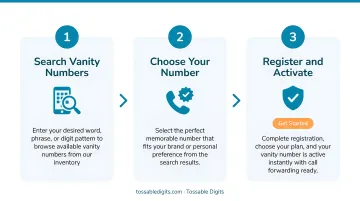
- Check availability through a virtual phone number provider
- Verify no trademark conflicts with your chosen word or phrase using the USPTO trademark database
- Consider registering variations to prevent competitors from claiming similar numbers
One more thing worth knowing before you commit: vanity numbers can be local, toll-free, or international. Under FCC rules (47 CFR § 52.101), toll-free numbers are fully portable between telecommunications providers, so you keep your number if you ever switch carriers.
Getting Started with Tossable Digits
Tossable Digits offers both local and toll-free vanity phone numbers with no premium fees for numbers in stock. The service includes:
- Call forwarding to any existing phone globally
- Voicemail-to-email with MP3 attachments
- SMS capabilities (on toll-free numbers)
- IVR/auto attendant for professional call routing
- Call recording for training and compliance
- RoboCall blocking to filter spam
All features are included at no extra cost per plan. Tossable Digits operates on a no-contract basis, so small businesses, real estate professionals, and marketers can activate a number quickly and cancel anytime.
Frequently Asked Questions
Is the number sign a hashtag or a pound sign?
These are two different names for the same symbol. "Pound sign" is the American phone/telephony term, "hash" is the UK/programmer term, and "hashtag" technically refers to the # symbol combined with a word used for social media tagging—not the symbol itself.
Why is the pound sign called a hashtag?
The symbol was already called "hash" in the UK and among programmers. When Twitter adopted it for topic tagging in 2007 (inspired by IRC usage from 1988), the combination of hash + tag created "hashtag," which became so widely used that many people now call the symbol itself a hashtag.
What is a hashtag number?
There is no official term "hashtag number." It usually means one of two things: the # symbol used as a number sign (for example, #2 = "number 2"), or a vanity phone number that spells out a word using the keypad's letter-to-number mapping.
How do vanity phone numbers actually work when you dial letters?
Each number key 2–9 on a standard phone keypad corresponds to a set of letters. Dialing a word like FLOWERS automatically sends the same tones as its numeric equivalent (356-9377), so the call routes exactly the same way.
Can I get a local vanity phone number, or are they only available as toll-free numbers?
Local vanity numbers are available—businesses can choose a number with their local area code that spells out a relevant word or phrase. They're often a better match for neighborhood-focused businesses that don't need a national presence.