Introduction
Moving abroad often means losing access to the U.S. phone number that banks, financial platforms, and everyday services depend on—and the consequences can be surprisingly disruptive. When Wells Fargo blocks your login because it can't send a verification code, or when your brokerage account locks you out mid-transaction, that missing U.S. number becomes a real problem fast.
Getting a U.S. number from overseas sounds simple, but choosing the wrong method can leave you locked out of the accounts that matter most. Some solutions work well for calls but fail when a bank rejects the number for SMS verification. Others cost far more than necessary or stop working after a few months abroad.
This guide breaks down every practical option—virtual numbers, virtual phone apps, international SIM plans, and more—so you can choose the one that actually fits your situation.
Key Takeaways
- Virtual phone numbers (virtual phone) offer the fastest, most flexible way to get or keep a U.S. number from anywhere
- Two-factor authentication is the top reason expats need a U.S. number, and not all virtual providers support it — so pick carefully
- No U.S. address or physical SIM required—setup happens entirely online in minutes
- Porting your existing number before leaving the U.S. avoids complications down the road
Why Expats Need to Keep a U.S. Phone Number
Two-factor authentication is the most pressing reason to keep a U.S. phone number abroad. Banks, brokerages, and government platforms send one-time codes via SMS—and without a U.S. number, expats face complete account lockouts. According to Google Security research, SMS-based two-step verification stops 100% of automated attacks, which explains why financial institutions rely on it so heavily.
The catch: those codes expire fast. Wells Fargo validation codes last just 8 minutes, while Bank of America and Citibank codes expire after 10 minutes. Delayed SMS delivery abroad means missed access windows and locked accounts.
Reachability is the second major concern. U.S. employers, healthcare providers, insurance companies, and personal contacts all use a stored U.S. number to reach you. Drop it, and those calls either fail silently or get flagged as international spam—complicating everything from appointment confirmations to insurance claim verification.
Many U.S. services require a U.S. phone number for registration or verification. Streaming subscriptions, online retailers, loyalty programs, and app sign-ups often reject international numbers during account creation. Even routine tasks—registering a new credit card, updating your address with the DMV, or signing up for a loyalty program—typically require a U.S. contact number. For expats who keep using these services, keeping that number isn't optional.
The three core needs, summarized:
- 2FA access: Receive time-sensitive SMS codes from banks, brokerages, and government accounts
- Staying reachable: Ensure U.S. employers, doctors, and insurers can reach you without call failures
- Service registration: Meet phone verification requirements for U.S. subscriptions, apps, and accounts
4 Ways to Get a U.S. Phone Number as an Expat
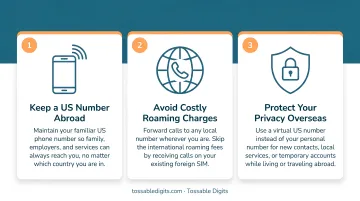
Expats have four main options, each with distinct trade-offs around cost, reliability, flexibility, and use case fit. Your choice depends on which services you need to access, how much you're willing to spend, and whether your stay abroad is temporary or permanent.
Virtual Phone Number (virtual phone)
A virtual U.S. phone number works over the internet via virtual phone technology, requires no physical SIM card or U.S. address, and can receive calls and SMS from anywhere in the world. For most expats who need flexibility without hardware requirements or carrier contracts, this is the most practical starting point.
Key limitations exist. NIST SP 800-63B (2020) explicitly prohibits virtual phone numbers for out-of-band authentication, which led major institutions to systematically block them. ID.me (used by the IRS) states: "For security reasons, Voice-over-IP (VOIP) phone numbers are not accepted." Bank of America's Zelle service and Wells Fargo similarly reject virtual phone numbers for 2FA. Expats with heavy financial account needs should verify compatibility before relying on this method alone.
Keeping Your Existing U.S. Carrier Plan
Expats on carriers like T-Mobile with international plans can continue using their existing U.S. number abroad. This approach is reliable for 2FA since you're using a traditional mobile number, but it becomes expensive as a long-term solution.
Carriers actively monitor international roaming. T-Mobile warns that its plans are "not for extended international use" — if more than 50% of usage occurs internationally for over two months, roaming data gets blocked. Verizon similarly restricts services when over 50% of talk, text, or data usage in a 60-day period happens in Canada or Mexico.
Pricing compounds the problem quickly. AT&T's International Day Pass costs $12 per day, capped at 10 daily fees per billing period, which adds up to $120 monthly — well above what virtual number alternatives typically cost.
Porting to a Prepaid or Dormant U.S. Plan
Transfer your current number to a low-cost prepaid plan before leaving the U.S., keep it active minimally with occasional top-ups, and use it exclusively for 2FA and inbound calls. This method proves more reliable for sensitive 2FA than virtual numbers since you maintain a traditional mobile number, but requires keeping the physical SIM card functional.
Inactivity policies vary by carrier and can catch expats off guard:
- Tracfone deactivates smartphones after 6 months without voice, text, or data usage
- H2O Wireless cancels accounts when the balance hits $0 for 30 consecutive days
- H2O also expires unused balances after 90 days on $10–$30 Pay As You Go plans
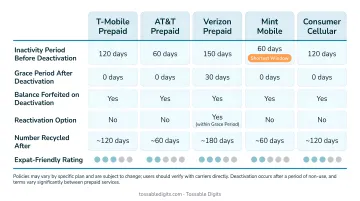
Plan periodic top-ups — even a small one every few months — to prevent losing the number.
Physical SIM Card or eSIM
Purchasing a U.S. SIM from a carrier or using a U.S.-compatible eSIM provides a real U.S. number, but typically requires a U.S. address and in-person purchase. AT&T eSIM setup requires entering the billing ZIP code associated with the account. T-Mobile's Prepaid eSIM app requires credit card information including a U.S. billing ZIP code to complete download.
This option suits expats who frequently return to the U.S. better than full-time overseas living. If you maintain a U.S. address and visit regularly, eSIM provides legitimate carrier numbers that work everywhere. For permanent expats without U.S. addresses, the setup barriers make this approach impractical.
How to Get a U.S. Virtual Phone Number: Step-by-Step
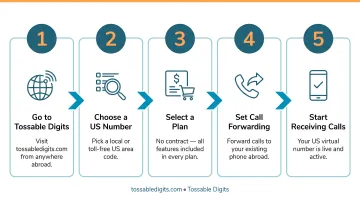
The virtual phone number route is the most practical option for expats—setup happens entirely online in minutes, no U.S. address required, and it works from any country. Follow these five steps to get your U.S. number operational.
Step 1: Choose a Reliable Virtual Phone Number Provider
Provider selection is critical. Look for services offering U.S. local numbers with your preferred area code, supporting international call forwarding, delivering SMS reliably, and maintaining strong uptime records.
Tossable Digits has offered virtual U.S. numbers since 2005, with every feature—call forwarding, voicemail-to-email, SMS, call recording—included in every plan. No contracts, cancel anytime. Numbers span 500+ U.S. cities across all 50 states, with popular area codes readily available:
- New York: 212, 718, 917
- Los Angeles: 213, 310, 323
- Chicago: 312, 773
- San Francisco: 415
Step 2: Sign Up and Select Your U.S. Number
Create your account online, choose a plan, and select your U.S. phone number. Many providers allow you to choose your area code, which helps maintain a familiar regional presence. No U.S. address is typically required—you can complete the entire registration from anywhere in the world.
Tossable Digits lets you search available numbers by area code and activate them within minutes. With millions of local numbers in stock, you can usually find your preferred area code without delays.
Step 3: Configure Call Forwarding to Your International Number
Point your new U.S. number to your current local mobile number abroad so calls ring through wherever you are. Tossable Digits supports forwarding to international numbers in virtually every country, so you can receive calls on a local SIM card abroad without callers knowing you've left the U.S. Calls connect instantly, regardless of where you're based.
Step 4: Set Up SMS and Voicemail Delivery
Configure SMS-to-email or app-based SMS delivery so text messages—including 2FA codes—reach you reliably even without a cellular connection. Voicemail-to-email with MP3 attachments works well for checking messages across time zones—no need to dial in, just open your inbox.
With Tossable Digits, voicemails arrive as MP3 attachments to whichever email address you designate. You can route different virtual numbers to different email addresses, keeping messages organized from day one.
Step 5: Test the Number Before You Rely on It
Test the number by sending a test SMS (ideally through a 2FA-style service) and placing a test call before depending on it for critical access. Verify that at least one important financial account accepts the new number for 2FA before fully transitioning. Try a low-stakes service first—a streaming subscription or retail loyalty program—to confirm SMS delivery works. Then test with a secondary financial account before updating your primary bank or brokerage.
What to Look for in a U.S. Virtual Phone Number Provider
Not all virtual number providers offer the same reliability, features, or compatibility. The wrong choice leaves you without access to 2FA codes at critical moments. Evaluate providers using these criteria.
Reliable SMS Delivery for 2FA
SMS delivery reliability is the most important technical criterion. 2FA codes are time-sensitive—TOTP (Time-based One-Time Password) standards use 30-second default time-step sizes, while Microsoft Authenticator verification codes change every 30 seconds. Providers with delivery delays or inconsistent SMS routing fail at the most important moment.
Look for providers with documented uptime records and user reviews specifically mentioning 2FA use. Providers with 20-year track records and verified BBB A+ ratings offer a level of operational stability that newer entrants simply haven't had time to prove.
International Call Forwarding to Any Number
Global call forwarding capability is essential for expats. The provider must support forwarding to international phone numbers, not just U.S. destinations. Some providers charge extra for international forwarding or restrict it to certain countries.
Tossable Digits forwards calls to any phone worldwide at competitive rates, with no country restrictions on forwarding destinations — so your U.S. number reaches you no matter where you're based.
Flexible Pricing With No Long-Term Contracts
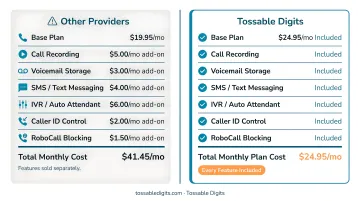
Expat situations change frequently. A provider with no contracts, month-to-month billing, and transparent pricing—no per-feature fees—offers the flexibility expats need. Tossable Digits includes all 60+ features in every plan — call recording, voicemail, SMS — with one flat price and no cancellation penalties.
Many competitors advertise low base prices, then add fees that stack up fast:
- SMS messaging: ~$5/month
- Call recording: ~$10/month
- Voicemail transcription: ~$7/month
- International forwarding: ~$15/month
Those add-ons can easily double or triple your actual monthly cost.
Number Portability
The ability to port an existing U.S. number into a virtual service—and port it out later if needed—gives expats continuity. No notifying contacts, no updating accounts across every platform you use.
FCC regulations require simple ports to be processed in one business day, with more complex intermodal ports (like wireless-to-virtual phone) completed within four business days.
Look for providers supporting both inbound and outbound porting. Tossable Digits accepts ported numbers from virtually any U.S. or Canadian carrier—including Verizon, AT&T, T-Mobile, Sprint, Google Voice, and Vonage—with no porting-in fees and typical completion in 1-5 business days. If you later decide to switch providers, you can port out anytime with no early termination charges.
Common Mistakes Expats Make When Getting a U.S. Phone Number
Relying Solely on Free Services Like Google Voice
Free services carry real risk for long-term expat use. Google Voice reclaims numbers after 3 months of inactivity — and incoming calls and texts don't count. Only outbound activity resets the 90-day countdown. Miss the window, and you get 45 days to reclaim the number before it's gone permanently.
The free tier is also shrinking. Microsoft discontinued Skype Numbers in December 2024 and is retiring Skype entirely in May 2025. Paid virtual number services offer greater long-term stability.
Waiting Until After You Leave to Port Your Number
Porting is far easier while you still have active U.S. service. Attempting it from abroad can introduce delays, complications, or outright failures during the transition window. Common friction points include:
- Carriers requiring identity verification that's harder to complete internationally
- Being asked to call from the number being ported — impossible once you've canceled service
- Timing gaps that leave you without a working number mid-move
Not Testing 2FA Compatibility Before Switching Numbers
Some platforms — particularly U.S. banks, the IRS, and financial institutions — reject virtual virtual phone numbers for SMS two-factor authentication. Test your new number on those accounts before removing your old one.
Log into your bank, brokerage, and any critical government accounts and try updating the phone number on file. A rejection there tells you immediately, rather than when you're locked out mid-transaction.
Frequently Asked Questions
How to get a US phone number as an expat?
Sign up for a virtual phone number service online, select a U.S. number with your preferred area code, and configure call forwarding to your international mobile number. No U.S. address or SIM card required—the entire process takes minutes and works from any country.
Can I get a virtual phone number for another country?
Yes. Tossable Digits, for example, provides virtual numbers from 84 countries worldwide—including the UK, Germany, France, Australia, Japan, and Canada. Expats can maintain both a U.S. number and a local number in their country of residence at the same time.
Can I get a US phone number with an eSIM?
eSIMs can provide a U.S. number tied to a carrier plan, but these typically require a U.S. billing address and ZIP code for activation. They're better suited for frequent travelers than permanent expats. Virtual phone numbers are easier to obtain and maintain from abroad without address requirements.
Can I get a US number without an address?
Virtual phone number providers do not require a U.S. address. You can sign up and receive a U.S. number online from any country, unlike physical SIM cards or carrier plans, which typically require a domestic address.
Does a virtual US phone number work for two-factor authentication?
Most virtual numbers work for 2FA on everyday apps and services. However, some U.S. financial institutions and government platforms reject virtual phone numbers due to NIST security guidelines. Test compatibility with your specific accounts—particularly banks, brokerages, and IRS portals—before fully switching your primary number.
Can I keep my existing US phone number when I move abroad?
Yes, you can port your existing U.S. number to a virtual phone number service—ideally before leaving the country. Your contacts and accounts keep reaching you on the same number regardless of where you live.