Introduction
Miss a call from a client because your local SIM changed your number. Get locked out of your bank account because SMS verification went to a number you no longer have. These are real problems digital nomads hit within the first few weeks on the road. The wrong phone setup can quietly unravel your income and access.
Most nomads are actually juggling two distinct needs: keeping a permanent home country number for banking, clients, and two-factor authentication — and picking up a workable local or international number in each new country. This guide walks through both, covering virtual numbers, eSIMs, forwarding strategies, and what to look for before you book your next flight.
Key Takeaways
- Virtual phone numbers (like Tossable Digits) keep a US number active abroad, forwarding calls to any local number or device you're using
- eSIMs and local SIM cards handle data and local calling needs country-by-country; they don't replace your home number
- Google Voice offers a low-cost option for preserving a US number, but comes with privacy trade-offs and limited features
- The best setup pairs a virtual home number for continuity with a travel eSIM or local SIM for affordable data
- Before leaving, verify device compatibility, unlock your phone, and test your forwarding setup
Why Getting Your International Phone Setup Right Actually Matters
Losing access to a home number abroad creates immediate, serious consequences. SIM swap scams cost victims an average of $26,400 in 2024, highlighting the danger of losing control over your primary number. You can be locked out of bank accounts requiring SMS verification, miss client calls that go to a disconnected line, and lose access to government accounts tied to your number.
Digital nomads need to solve two distinct problems simultaneously:
- Number continuity — your home or business number stays reachable and functional no matter where you are
- Local connectivity — cost-effective data and calling in each country without roaming fees eating your budget
Mixing up these two needs leads to the wrong setup. The right solution depends heavily on trip length, call frequency, how many countries you'll visit, and whether you're maintaining a business or personal presence. The sections below break down options for both short-term travelers and long-term nomads managing a business presence.
How to Get an International Phone Number as a Digital Nomad
Define What "International Phone Number" Means for Your Situation
Distinguish between three distinct goals:
- Preserving your existing home country number while abroad
- Getting a new virtual number with a specific country code (e.g., a US number for a nomad based in Europe)
- Getting a temporary local number for each country visited
Defining this upfront determines which tools to use — a virtual number service, a number-porting solution, an eSIM, or a local SIM — and prevents paying for overlapping services.
Check Your Phone's Compatibility and Carrier Lock Status
Before traveling, ensure your device is unlocked and eSIM-capable.
Carrier Lock Status:
You cannot install a travel eSIM on a locked phone. Check your carrier's unlock policy:
- AT&T: Device must be purchased 60+ days ago, paid in full, with account current
- Verizon: Devices unlock automatically when purchased at full retail price or 60 days for postpaid, 365 days for prepaid
- T-Mobile: Postpaid devices must be active for at least 40 days and paid in full
eSIM Compatibility:
By 2025, approximately 60% of all smartphone unit sales were eSIM-compatible. Modern flagship devices support dual-eSIM functionality:
- Apple: iPhone 13 and later support dual eSIM with two eSIMs simultaneously
- Google Pixel: Pixel 7, Pixel 7 Pro, and later can use 2 eSIM profiles at once
- Samsung: Galaxy S24 Series and later support dual eSIMs concurrently
Dual-eSIM phones let you run a home virtual number and a travel eSIM simultaneously — no physical SIM swapping required.
Choose Your International Phone Number Solution
1. Virtual Phone Number Service
A virtual number lets you get or keep a US (or other country) number that forwards calls to any device globally, no SIM swap required.
Tossable Digits, for example, offers US, Canada, and international virtual numbers across 84 countries with comprehensive features:
- Call forwarding to any phone number worldwide
- SMS messaging (on US/Canada numbers)
- Voicemail-to-email with MP3 attachments
- Call recording with automated compliance announcements
- IVR (auto-attendant) for professional routing
- RoboCall blocking
- All 60+ features included in every plan with no contract
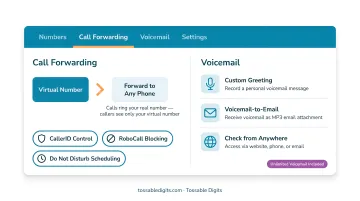
Your number stays the same whether you're in Chiang Mai or Lisbon — callers reach you the same way they always have, and you're never paying roaming charges just to receive calls.
2. Google Voice
Google Voice provides a free US number that routes calls and texts over Wi-Fi or cellular data.
Limitations:
- Some websites, such as banks or subscription services, won't send text messages to Google Voice numbers
- Forwarding calls to automated systems unsupported on free tier
- All communications metadata integrated into Google's ecosystem
- International calling incurs per-minute charges
3. Travel eSIM Providers (Airalo, Saily)
Ideal for local data in 100+ countries, but eSIMs from travel providers like Airalo are data-only plans — they provide an internet connection but not a callable phone number.
- Airalo: Discover Global plan starts at $8.50 USD for 1GB/7 days
- Saily: Global plan starts at $8.99 for 1GB/7 days
Neither option provides a stable, long-term number — they're data tools, not communication identity solutions.
4. Local Physical SIM
The cheapest option for local data, but each country means a new number. You lose continuity and must notify every contact of the change each time you move.
Set Up Call Forwarding and Voicemail for Global Access
Call Forwarding Configuration:
Configure your virtual number to forward calls to wherever you currently are — a local SIM number, a softphone app, or any phone number globally. Callers never know you've moved. The virtual number handles all routing behind the scenes — you just update the forwarding destination when you land somewhere new.
Voicemail-to-Email Setup:
Voicemail-to-email delivers recorded messages as MP3 attachments straight to your inbox — no dialing in, no time zone juggling. Tossable Digits includes this in every plan, so a message left at 3am your time is waiting in your inbox when you wake up.
Test the Full Setup Before You Leave
Verify before departing:
- Call forwarding routes correctly
- Voicemail is reachable via email
- SMS arrives at the right destination
- Two-factor authentication codes still reach you on the number tied to key accounts
Do a full test call and text from a friend while still on home soil. Testing internationally with roaming active (before relying on the new setup) helps catch configuration errors before they cause access lockouts.
Key Factors That Determine Which Option Is Right for You
Trip Length and Frequency
- Short-term travelers (under 3 months, one country): Carrier roaming plans plus call forwarding may suffice
- Long-term nomads visiting multiple countries: Need the stability of a virtual number plus flexible travel eSIMs
Call Volume Needs
- Occasional verification texts: Basic call forwarding or a free Google Voice number is usually enough
- Frequent client calls: A stable virtual number with IVR, call recording, and voicemail-to-email is the better fit
Cost Structure
| Solution Type | Approximate Cost | Key Limitations | |--------------|------------------|-----------------|\n| US Carrier Roaming (AT&T/Verizon) | $12/day ($360/month) | Throttled after daily limits; extremely expensive | | Travel eSIM (Airalo/Saily) | $8.50–$8.99 (1GB/7 days) | Data-only; no phone number | | Google Voice | $0/month | Free US calls/texts; some 2FA SMS blocked | | Virtual Number (Tossable Digits) | Varies by plan | Full feature set; no roaming fees |
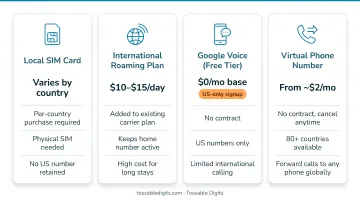
Carrier international roaming is typically the most expensive option per month, while combining a virtual number with a local eSIM tends to be the most cost-efficient for full-time nomads.
Privacy and Reliability
Google Voice collects call and message log information including phone numbers, call durations, and routing details. Google states they don't serve ads in telephony services, but personal information can be shared with telephony providers or disclosed to government authorities under applicable law.
Dedicated virtual number services like Tossable Digits operate independently, which matters for nomads running a business or handling sensitive client communication. Key differences worth comparing:
- Data practices: Independent providers don't bundle call data into a broader consumer platform
- Feature depth: Business-grade features (IVR, call recording, call screening) are standard, not add-ons
- Compartmentalization: Separate your professional number from personal accounts and travel SIMs
What You Need to Have Ready Before You Set Up
Device Readiness:
- Confirm the phone is unlocked
- Verify eSIM-compatibility if needed
- Know which SIM slot or eSIM profile to assign for calls vs. data
- Dual-SIM-capable phones eliminate significant setup complexity
Account and Number Audit:
List all accounts tied to your current phone number before changing or forwarding anything:
- Banking apps and websites
- Email recovery settings
- Government portals
- Two-factor authentication apps
- Professional contacts and clients
Missing even one of these — especially a banking app or 2FA account — can lock you out at the worst possible time, like when you're mid-transit and can't receive verification codes.
Number Porting Timeline:
Once your accounts are audited, you can move forward with porting. If transferring a number from a carrier to a virtual provider, FCC rules require simple ports to complete within one business day. You'll need:
- Your 10-digit phone number
- Your account number
- A PIN/passcode from your current carrier
Build in at least 2–3 business days before your departure date to account for carrier delays or verification hiccups.
Common Mistakes Digital Nomads Make with International Phone Numbers
A few avoidable errors catch digital nomads off guard when managing international numbers. Here are the three most common — and how to sidestep each one.
Canceling Your Home Plan Before Setting Up a Replacement
The FCC explicitly warns: "Do not terminate your service with your existing company before initiating new service". Many nomads cancel their domestic carrier plan without first porting the number or configuring forwarding, permanently losing a number tied to years of contacts and accounts.
- The fix: Set up the new solution first, verify it works, then cancel the old service.
Relying Solely on a Messaging App Like WhatsApp
WhatsApp works well for peer-to-peer communication, but it doesn't function as a real phone number for SMS verification, client callbacks, or voicemail. You must receive a standard SMS or voice call to register a WhatsApp account, and standard SMS messages — including bank OTPs — can't be received through it.
- The fix: Use WhatsApp alongside a virtual number, not instead of one.
Ignoring Roaming Settings and Burning Through Data
Installing a travel eSIM doesn't automatically disable roaming on your home SIM. If your home SIM stays as the default data line — or if "Allow Cellular Data Switching" is left on — your phone may silently route traffic through it, resulting in unexpected carrier charges even after switching to the travel eSIM.
- The fix: After activating your travel eSIM, manually set it as the default data line and disable cellular data switching.
Frequently Asked Questions
Can I keep my US phone number while living abroad long-term?
Yes, a virtual phone number service allows you to maintain a US number indefinitely regardless of where you live, forwarding calls and SMS to whatever local number or device you're using at the time.
What's the difference between a virtual phone number and an eSIM?
A virtual phone number is a software-based number that forwards calls to any device, anywhere in the world. An eSIM is a digital SIM card that provides local data and calling in a specific country — both are useful, but they do different jobs.
Do I need a local phone number in every country I visit?
For most nomads, no. A virtual home country number handles incoming calls and texts, while a travel eSIM handles local data. You'd only need a local number for services that specifically require local number registration.
How does international call forwarding work with a virtual phone number?
When someone calls your virtual number, the service routes it to whatever number you've set as your forwarding destination — your local SIM, a virtual phone app, or any phone globally. Neither you nor the caller pays roaming fees.
Is there a phone number for eSIM?
eSIMs from travel providers like Airalo or Saily are typically data-only plans — they provide an internet connection but not a callable phone number. If you need a stable number, pair your travel eSIM with a virtual phone number service.
Does +44 count as 0 or 07?
When dialing a UK number internationally, the +44 country code replaces the leading 0 — so a number like 07911 123456 becomes +44 7911 123456. The 0 is dropped when the country code is added.