Introduction
If you're considering a virtual number to protect your privacy, you've probably wondered: Can it actually be traced back to me? Virtual numbers are marketed as privacy shields, but how much of that protection is real — and how much is marketing?
Virtual numbers do offer meaningful privacy for everyday use — they effectively hide your real phone number from contacts, businesses, and strangers. But they are not untraceable under all circumstances. Law enforcement can access provider records with proper legal authority, and everyday risks like recycled numbers or weak account security can expose you far more easily than a court order ever will.
The gap between those two realities is what this guide covers.
Key Takeaways
- Virtual numbers hide your real phone from contacts but aren't anonymous—providers retain account data and call metadata
- Law enforcement can trace virtual numbers with subpoenas, pulling provider records and IP logs
- Bigger privacy risks include recycled numbers, weak passwords, and unregulated providers
- Vet providers for clear data policies, encryption, 2FA, and BBB accreditation
- Never link high-stakes accounts (banking, government IDs) to virtual numbers
Can Virtual Phone Numbers Be Traced?
"Traceability" means different things in different contexts. Being identified by a random person who calls you is fundamentally different from being traced by law enforcement with a court order—and virtual numbers handle each scenario very differently.
The key distinction: virtual numbers do not expose your real phone number or physical address to the people you call or text. Your personal identity stays hidden in ordinary interactions, which is the primary privacy benefit most users seek.
The Privacy Protection Virtual Numbers Provide by Default
When you use a virtual number, the recipient only sees that virtual number—not your personal cell, carrier account, or billing address. This makes virtual numbers highly effective for separating your personal identity from public communications, such as:
- Online marketplace transactions (Craigslist, Facebook Marketplace)
- Business listings and customer-facing contact info
- Dating apps and social networks
- Temporary projects or contract work
Unlike a traditional carrier-registered number, a virtual number cannot be reverse-searched through standard carrier databases to find a registered name or home address. That blocks casual snooping, data broker lookups, and unwanted contact from people who find your number online.
When Tracing Becomes Possible
Virtual numbers are registered with telecom providers and subject to the same regulatory framework as traditional numbers. Providers hold account data that can be accessed through legal process, including:
- Name and email address on file
- Payment information
- IP address logs
Law enforcement agencies can obtain this information via subpoenas or court orders, and reputable providers are legally required to comply. Legitimate services are built with this accountability in mind—it deters criminal misuse while leaving everyday privacy protections intact for lawful users.
How Virtual Numbers Are Traced: Methods and Limits
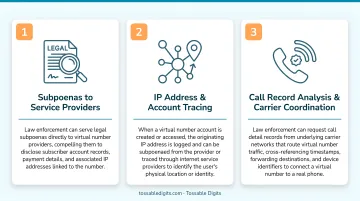
When investigators pursue a virtual number, they have several methods available to them:
IP Address Tracing
Every virtual phone call or SMS initiated through a virtual number app connects to the provider's servers over the internet, logging the originating IP address. Investigators can use this to identify the internet connection and, by extension, the account holder via the ISP. According to CISA guidance on mobile communications, IP data is a critical identifier in digital forensics.
Call Detail Records (CDRs)
Virtual number providers retain metadata on every call and message. Law enforcement can obtain these records through legal requests and use them to build investigative timelines. CDRs typically include:
- Timestamps and call duration
- Originating and receiving phone numbers
- Patterns of contact that establish associations between parties
Provider Account Data
Law enforcement can contact virtual number providers directly with legal process — subpoenas, court orders, or CALEA-compliant requests — to obtain account registration data. This typically includes the email address, payment method, and IP addresses logged at signup and login.
The Limits of Tracing
Factors like VPN use, dynamic IP addresses, disposable payment methods, and a provider's data retention policy can all complicate tracing efforts — but they create friction, not a guarantee of anonymity. VPNs mask the network-path IP address but do not erase logs held by the provider, and many VPN services themselves have data retention practices worth scrutinizing.
Privacy Risks Beyond Traceability
For most users, the real privacy threat is not law enforcement—it is everyday risks that can expose personal information without any legal process being required.
Recycled and Shared Numbers
The recycling of phone numbers is far more common than most people realize, and it poses serious privacy risks. According to the FCC, approximately 35 million phone numbers are disconnected annually in the United States, and a 2021 Princeton University study found that 83% of sampled available numbers were recycled.
When you acquire a virtual number, you could inherit someone else's digital footprint:
- Account associations: 66% of recycled numbers were still linked to existing online accounts at popular websites like Amazon and Yahoo
- Two-factor authentication texts: Nearly 10% of recycled numbers received security-sensitive communications meant for previous owners within just one week
- Inherited search profiles: The number may already appear in people-search databases, surfacing the previous owner's name, address, and other personal details
Low-cost providers often reassign numbers quickly to minimize inventory costs. The Princeton study observed an 86.5% monthly turnover rate, meaning an available number is typically claimed by a new user in just 1.2 months. This rapid reassignment means the digital footprint of a previous owner is rarely erased before the number changes hands.
Account Takeover and Credential Risks
Virtual number accounts secured only by a weak password are vulnerable to credential stuffing and phishing attacks. If someone gains access to your account, they can intercept your calls, SMS messages, and any 2FA codes tied to that number, giving them control over your entire identity layer.
This mirrors traditional SIM-swap attacks. Attackers can use a compromised virtual number account to reset passwords on email, banking, or other services tied to that number. Many users adopt virtual numbers specifically for privacy, then leave the account itself poorly secured — turning it into a single point of failure.
Unregulated or Low-Quality Providers
Your account security only matters as much as your provider's infrastructure behind it. Providers without transparent privacy policies, compliance certifications, or documented data handling practices may not encrypt communications, may sell user metadata, or may fail to notify users of breaches.
What to look for in a provider's privacy policy:
- Clear data retention timelines (how long they store IP logs, call records, account data)
- Encryption standards for calls and SMS in transit and at rest
- Compliance with privacy regulations (CCPA, GDPR where applicable)
- Disclosure of third-party data sharing practices
- Documentation of law enforcement request protocols
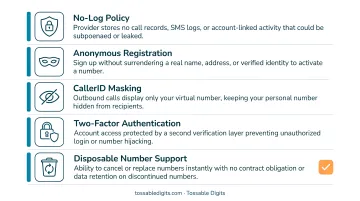
Reputable providers will clearly state how they protect your data and under what circumstances they will release it.
Common Privacy Mistakes Virtual Number Users Make
Even with a virtual number, certain habits can undermine the privacy you're trying to protect. These are the most common mistakes to avoid:
Don't Link High-Stakes Accounts to Virtual Numbers
Banking apps, government IDs, and primary email accounts need a dedicated, carrier-registered mobile number for verification. Virtual numbers can expire, be recycled, or change providers — creating continuity and security risks for accounts where access loss is serious.
Secure the Virtual Number Account Itself
Protecting your identity with a virtual number means nothing if the account managing that number is easy to compromise. Enable two-factor authentication on your virtual number account to prevent unauthorized access and takeover. Tossable Digits includes two-factor authentication on every account at no extra cost.
Avoid Free or Unverified Services
Free virtual number services typically monetize user data, draw from recycled number pools, and offer no recourse when something goes wrong. That trade-off directly contradicts the privacy you're trying to achieve — pay for a reputable service or skip the virtual number entirely.
How to Choose a Virtual Number Provider That Protects Your Privacy
When evaluating a provider's privacy posture, prioritize these criteria:
- States clearly how long it stores IP logs, call records, and account data
- Documents encryption standards for communications in transit and at rest
- Offers (and actively encourages) two-factor authentication for account access
- Discloses CCPA compliance, regulatory obligations, and law enforcement response protocols
- Carries BBB accreditation and a verifiable operating history
Once you've checked those boxes, look at how the provider structures its plans. Some charge extra for basic protections like 2FA or robocall blocking — others include them across every tier. Tossable Digits bundles every feature into every plan with no contract required, and has offered privacy-focused virtual numbers since 2005 with an A+ BBB rating.
Check what personal information a provider collects at signup and how long it keeps it. A reputable provider asks only for what's needed to provision the number — and tells you exactly what it does with that data.
Frequently Asked Questions
Can the police trace a virtual phone number?
Yes, police can trace a virtual phone or virtual number with proper legal authority. They can subpoena the provider for account records, IP logs, and call detail records, and reputable providers are legally required to comply with valid law enforcement requests.
Can someone trace a virtual phone number back to my real identity?
Ordinary individuals cannot reverse-lookup a virtual number to find the account holder's real name or address. The provider holds that information and will produce it only under legal process — so you have strong practical privacy from the public, but not from law enforcement.
Are virtual phone numbers truly anonymous?
Virtual numbers provide practical privacy by hiding your real number from contacts and businesses, but they are not truly anonymous. Providers retain account registration data, and that data is accessible through legal channels.
What data does a virtual phone number provider store about me?
Typical categories include account registration info (name, email, payment method), IP addresses used to access the account, and call/SMS metadata (timestamps, duration, numbers dialed). Providers don't typically store call content unless you enable call recording.
Is using a virtual number for privacy legal?
Yes, using a virtual number for privacy is legal. Virtual numbers are regulated by the same telecom authorities as traditional phone numbers.
Does using a VPN make my virtual number harder to trace?
A VPN masks the IP address associated with your virtual number activity, adding a layer of complexity to IP-based tracing. However, it does not affect provider-held account data (registration info, payment method) and should not be treated as a guarantee of anonymity.