Virtual toll-free numbers solve this problem by giving small businesses a credible, nationwide presence entirely through the cloud—no phone lines, no hardware required. They let business owners separate personal and business calls, project national credibility from day one, and manage communications from any device, anywhere. According to recent data, 85% of SMBs prioritize cloud-based phone deployments while traditional landlines fell 16% in 2024 alone.
This guide evaluates the best virtual toll-free number services in 2026, what features truly matter for small businesses, and how to avoid hidden costs that turn low advertised prices into expensive surprises.
Key Takeaways
- Virtual toll-free numbers use cloud-based technology, delivering a professional nationwide presence without traditional infrastructure
- Top 2026 providers: Tossable Digits (all-inclusive), Grasshopper (solopreneurs), Nextiva (scaling teams), Quo (remote workers), and 800.com (vanity numbers)
- Must-have features include IVR, call forwarding, voicemail-to-email, and SMS; confirm what's bundled vs. billed separately
- Starting January 2026, carriers require Business Registration Numbers for all toll-free SMS—verify your provider handles compliance
- All-inclusive, no-contract plans offer best value for teams wanting predictable costs
What Is a Virtual Toll-Free Number and Why Do Small Businesses Need One?
A virtual toll-free number is a cloud-based phone number with prefixes like 800, 888, or 877 that routes calls over the internet to any device—mobile, laptop, or desk phone—without requiring physical phone lines or dedicated hardware. The FCC recognizes 800, 888, 877, 866, 855, 844, and 833 as official toll-free prefixes, assigned on a first-come, first-served basis.
For small businesses, the advantages are concrete:
- Eliminates cost barriers for inbound inquiries, so customers call without hesitation
- Signals national credibility—even a one-person operation looks established with an 800 number
- Keeps your personal mobile number private while staying reachable for business calls
- Routes calls to any device, so you can work from anywhere without callers knowing
There's a useful distinction worth knowing: 72% of consumers prefer answering local numbers for outbound calls, yet toll-free numbers build professional credibility for inbound support. Toll-free works best for customer service lines; local numbers perform better for cold outreach.
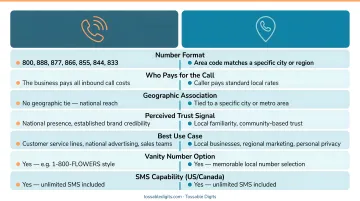
The sections below compare five providers specifically suited to small businesses, evaluated on affordability, feature transparency, and reliability.
Best Virtual Toll-Free Number Services for Small Businesses in 2026
These five services were selected based on feature completeness, transparent pricing, small-business suitability, and overall value—providers where toll-free is a core offering, not an expensive add-on.
Tossable Digits
Tossable Digits has provided virtual phone numbers since 2005, operated by Telusion, Inc. with BBB Accreditation and an A+ rating. It serves small businesses, real estate professionals, remote workers, and marketing teams across the US and internationally.
What makes it different: Every plan includes all features — unlimited SMS, call recording, IVR, voicemail-to-email with MP3 attachments, RoboCall blocking, and mobile app access — with no contracts and no feature gating. Tossable Digits offers toll-free, local, and international numbers in one platform, making it ideal for small businesses that want predictable costs without surprise charges.
| Feature | Details |
|---|---|
| Key Features | Unlimited SMS, Call Recording, IVR, Voicemail-to-Email with MP3, RoboCall Blocking, Virtual Number Groups, API Access—all included in every plan |
| Pricing Model | No contracts, month-to-month; transparent pricing with no per-feature charges or hidden fees |
| Best For | Small businesses, real estate agents, marketers tracking ad campaigns, remote workers, and travelers needing a US number abroad |
Tossable Digits includes business SMS on toll-free numbers — a capability many competitors charge extra for or restrict entirely. This matters for appointment reminders, order confirmations, and customer notifications.
Call recording includes automated verbal announcements for legal compliance, addressing varying state recording consent laws at no additional cost.
Grasshopper
Founded in 2003 and owned by GoTo, Grasshopper is one of the longest-standing virtual phone providers for solopreneurs and micro-businesses in the US and Canada. It offers toll-free, local, and vanity numbers with straightforward setup.
The key advantage: Grasshopper suits solo founders wanting a professional toll-free number without complex configurations. Vanity number options (e.g., 1-800-MYBRAND) are available through a direct search tool, making it strong for branding. Call recording, however, requires an upgraded plan.
| Feature | Details |
|---|---|
| Key Features | Call forwarding, voicemail-to-text, custom greetings, vanity toll-free numbers (800, 844, 855, 866, 877, 888), desktop and mobile apps |
| Pricing | True Solo starts at $14/month (1 number, 1 extension); Solo Plus at $25/month; Small Business at $80/month (4 numbers, unlimited extensions)—call recording included only on Small Business plan |
| Best For | Solo operators and micro-businesses wanting a simple, branded toll-free number without team collaboration needs |
Grasshopper charges $9/month for each additional phone number and offers flat-rate annual pricing that benefits small teams with predictable call volumes.
Nextiva
Nextiva positions itself as a full Unified Communications as a Service (UCaaS) platform serving SMBs and growing businesses. It combines internet-based calling, toll-free numbers, auto-attendants, and CRM integrations under one cloud-based solution. Gartner named Nextiva a Strong Performer in the 2025 'Voice of the Customer' for Contact Center as a Service.
Where it excels: Nextiva suits small businesses scaling beyond basic phone needs, offering call queues, team collaboration tools, and analytics. Toll-free numbers are restricted to higher-tier plans, so buyers should verify inclusion before purchasing.
| Feature | Details |
|---|---|
| Key Features | Auto-attendant, call queues, CRM integrations, analytics, team messaging, HD voice quality |
| Pricing | Core plan at $15/user/month (toll-free is add-on); Engage at $25/user/month (includes toll-free with up to 2,000 free minutes); Scale at $75/user/month (up to 10,000 minutes) |
| Best For | Small-to-mid businesses wanting an all-in-one communication platform with built-in scalability |
Reviews on Trustpilot and G2 praise Nextiva's call quality and onboarding support, but note complex initial setup, difficult contract exits, and auto-renewing multi-year agreements.
Quo (formerly OpenPhone)
Quo is a modern, app-first business phone platform built for small teams and startups. It rebranded from OpenPhone in September 2025 with $105 million in growth financing aimed at expanding AI-driven features. It supports toll-free and local numbers in the US and Canada.
Who it's built for: Quo suits distributed or remote small business teams needing shared number access, SMS automation, and AI call insights at accessible prices. Toll-free coverage is limited to US and Canada, so businesses with international caller bases should look elsewhere.
| Feature | Details |
|---|---|
| Key Features | Shared inboxes, AI call summaries and tags, voicemail transcription, call recording, SMS/MMS, CRM integrations (HubSpot, Salesforce, Zapier) |
| Pricing | Starter at $15/user/month (1 number per user); Business at $23/user/month (AI features included); Scale at $35/user/month—additional numbers cost $5/month each |
| Best For | Remote-first small businesses and startups needing collaborative, AI-enhanced phone system for US/Canada customers |
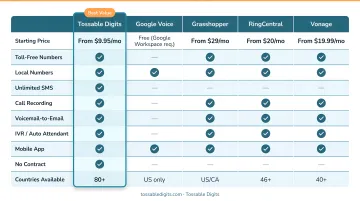
The "Sona" AI agent is included on all plans, but advanced AI features like call summaries and transcripts require the Business plan at $23/user/month. Quo includes a toll-free number on its base plan, unlike many competitors, but charges for each additional number.
800.com
800.com is a toll-free specialist provider focused exclusively on 800, 888, 877, 866, 855, 844, and 833 numbers, including custom vanity numbers. It operates as a certified Responsible Organization (RespOrg) for toll-free number administration.
The core appeal: 800.com makes it fast and simple to claim a memorable vanity toll-free number without wading through complex feature tiers. Plans differ mainly by minute allotments and line counts, and deep CRM integrations aren't available, so it fits basic toll-free needs better than growing teams.
| Feature | Details |
|---|---|
| Key Features | Vanity toll-free numbers, call forwarding, basic analytics, business texting, voicemail transcriptions, auto-attendant (IVR), call recording |
| Pricing | Startup plan at $19/month (1,000 minutes, 1 number); Small Business at $49/month (unlimited fair use, 3 numbers); Unlimited at $99/month (5 numbers)—AI transcriptions cost $0.03-$0.10/minute extra |
| Best For | Small businesses whose primary goal is a memorable, branded toll-free number with simple call forwarding |
Reviews on Trustpilot and G2 praise easy vanity number procurement and quick setup, but occasionally mention unexpected add-on fees for transcriptions and a technical interface.
Key Features to Look for in a Virtual Toll-Free Number Service
Feature Completeness vs. Feature Gating
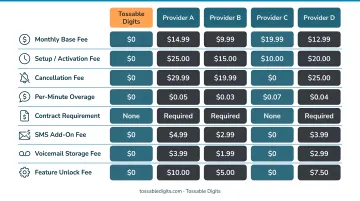
Many providers advertise low starting prices but charge separately for essentials like call recording, voicemail transcription, or IVR. Compare what's included at the base plan level, not just the headline price.
Common add-on fees across providers:
- Nextiva charges extra for call recording on the Core plan
- Quo charges $5/month for each additional number
- 800.com charges $0.03-$0.10 per minute for AI call transcriptions
- Grasshopper charges $9/month for extra numbers and requires Small Business plan for call recording
Providers like Tossable Digits include all features at no extra cost, making total cost of ownership significantly lower for feature-dependent workflows.
Call Routing and IVR
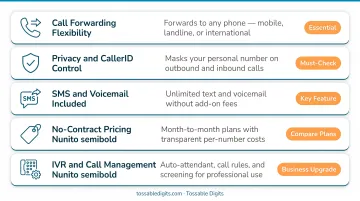
IVR (Interactive Voice Response) and smart call routing matter for small businesses because they allow callers to self-direct to the right department, creating a professional impression even when the owner is unavailable. A well-configured IVR menu (think: "Press 1 for Sales, Press 2 for Support") eliminates missed opportunities and reduces caller frustration. Verify how many menu levels and extensions the provider supports, and whether IVR is included or costs extra.
SMS and Voicemail-to-Email
Toll-free numbers that support two-way SMS enable customer confirmations, appointment reminders, and follow-ups—essential for service businesses. Starting January 2026, carriers require all toll-free SMS registrations to include Business Registration Numbers (EIN)—verify your provider handles compliance.
Voicemail-to-email with audio attachments ensures you never miss important messages. Many providers charge separately for transcription, but services like Tossable Digits include MP3 voicemail delivery in every plan.
Mobile App and Remote Access
For small business owners rarely at a desk, a reliable mobile app determines whether you can actually run your business on the go. Calls, voicemails, and messages should all be accessible from a smartphone without exposing a personal number.
Before committing, check whether the app supports:
- Call recording and playback
- Caller ID control for outbound calls
- IVR management — not just basic call forwarding
Privacy and RoboCall Protection
Most small businesses underestimate this until it becomes a problem. Keeping a personal number private, blocking robocalls, and assigning separate virtual numbers to different marketing channels lets you see exactly which ads are driving calls — without ever giving out your real number.
US consumers received 52.5 billion robocalls in 2025, with 57% being telemarketing and scams. RoboCall blocking should be automatic and included, not an add-on.
How We Chose the Best Virtual Toll-Free Number Services
Each service was evaluated across five criteria:
- Feature transparency — what's included vs. what costs extra
- Pricing fairness for small business budgets
- Ease of setup without IT support
- Call quality and reliability
- Fit for common use cases — solo operators, remote teams, marketing tracking, and customer service
Evaluation approach: Forbes Advisor evaluates virtual phone services based on Pricing (38%), General Call Features (25%), Customer Satisfaction (16%), Support (10%), and Product Testing (10%). PCMag relies on lab-based testing and reader surveys for reliability, cost, and ease of use assessments.
Small business owners frequently choose based on the lowest advertised price — then discover per-minute overage charges, feature add-on fees, or contract lock-ins that push actual costs higher. Reviews on G2, Trustpilot, and Reddit point to recurring friction: porting delays, AI-only support with slow resolution times, and auto-renewing contracts that are difficult to exit. Providers that surface total cost of ownership upfront scored better in this evaluation.
Conclusion
Virtual toll-free numbers are no longer just for large enterprises. In 2026, small businesses can project a professional, nationwide presence for a fraction of traditional telecom costs—provided they choose a provider that fits their workflow and doesn't charge separately for every basic feature.
Before committing to a provider, run through this short checklist:
- Prioritize all-inclusive, no-contract plans that grow with your business
- Confirm whether call recording, IVR, and SMS are bundled or locked behind a paywall
- Verify compliance with the January 2026 toll-free SMS regulations requiring Business Registration Numbers
If that checklist describes what you need, Tossable Digits is worth a close look. The platform has operated since 2005, holds a BBB A+ rating, and includes every feature across all plans with no contracts required.
Frequently Asked Questions
Is a free virtual number truly free?
Most "free" virtual numbers carry significant limitations—restricted minutes, ads, or free trials that convert to paid plans—because the business always absorbs the call cost. Most "free" virtual numbers carry significant limitations—restricted minutes, ads, or free trials that convert to paid plans—because the business always absorbs the call cost. For reliable business use, paid plans starting at $15–$25/month are the practical minimum to access features like IVR, SMS, and call recording.
Can I get a toll-free number for my business?
Yes, any small business can get a virtual toll-free number (800, 888, 877, etc.) through a cloud-based provider—no hardware or long-term contracts required. The FCC requires toll-free numbers to be portable, so you can switch providers without losing your number. Setup takes minutes and the number forwards to any mobile or landline.
How to get an American phone number while living abroad?
Virtual phone number providers like Tossable Digits let you obtain and maintain a US number that forwards calls to any phone globally. Expats, travelers, and international business owners can stay reachable on a US number from any country. No US residency or SIM card is required—the number runs entirely through cloud apps.
What number to forward calls to voicemail?
Most virtual toll-free providers include built-in voicemail—callers are automatically routed to voicemail when the line is unavailable. You can configure after-ring timeout settings through the provider's dashboard or mobile app; no separate forwarding number is required.
What are the best virtual number providers?
The top options for small businesses are Tossable Digits (all-inclusive, no contracts), Grasshopper (solopreneurs), Quo (remote teams), Nextiva (growing businesses), and 800.com (vanity toll-free). The best choice depends on whether your priority is price, features, scalability, or simplicity—and whether you need US-only service or international call forwarding.